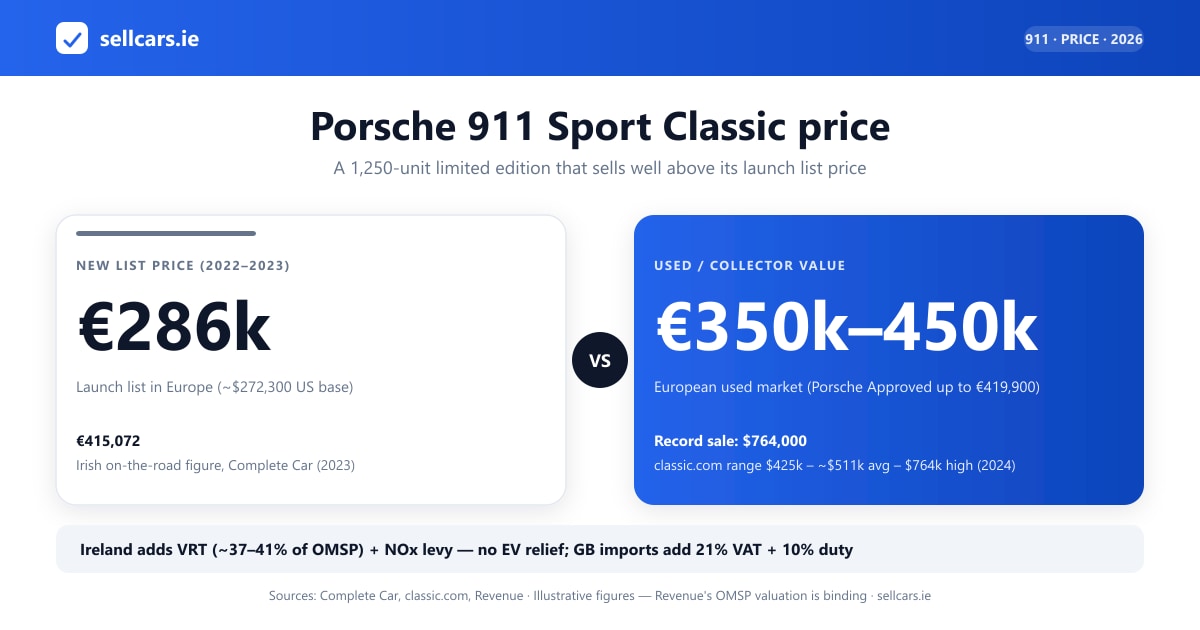
A Porsche 911 Sport Classic now costs far more than its original list price: the 992 version launched at around €286,000 (about $272,300 in the US), but as a strictly limited edition of just 1,250 cars it sells used for roughly €350,000 to €450,000, with record sales reported as high as $764,000. The "price" you should plan for is therefore a collector value above list, not a fixed showroom figure.
For an Irish buyer that figure is only the start, because as a petrol 911 the Sport Classic pays VRT at the highest band — with no electric-vehicle relief — and importing one adds VAT and customs duty on top. This guide turns the question "how much is a Porsche 911 Sport Classic?" into a real budget, with prices by market, a worked VRT example, and the full cost of bringing one into Ireland.
How much is a Porsche 911 Sport Classic?
A Porsche 911 Sport Classic launched at around €286,000 (about $272,300 in the US), but on today's used market it typically costs €350,000 to €450,000 — and the very best examples have sold for far more. Before looking at Ireland specifically, it helps to see the full price picture across markets, because the price of a Sport Classic is really a moving collector value, not a fixed list figure.
New list price vs real market value
When the 992 Sport Classic arrived, the new list price was reported at roughly €286,215 in Europe, with a US base price near $272,300. That was already an extraordinary figure for a 911 — but it has proved to be a floor rather than a ceiling. Because demand far outstripped the 1,250-car run, prices on the used market quickly climbed past list, and they have stayed there.
In other words, the realistic price to budget for is a second-hand or collector price above the original list, not the launch figure. A car that cost around €286,000 new is now a €350,000-plus proposition before you have paid a cent of Irish tax.
Price by market: Ireland, UK, Europe and record sales
Prices vary noticeably depending on where you buy, the car's mileage and its history. The figures below are illustrative market references drawn from published reviews, dealer listings and recorded sales — they are not fixed quotes, and the right number for a specific car depends on its condition.
| Reference | Price (illustrative) | Notes |
|---|---|---|
| New list price at launch (2022/2023) | ≈ €286,000 / ~$272,300 (US base) | Original Porsche list / MSRP |
| Irish market (Complete Car, 2023) | €415,072 + options | Irish on-the-road review figure |
| Irish used market | ≈ €320,000–€420,000 | Varies with condition and mileage |
| European used market | ≈ €350,000–€450,000 | Porsche Approved listings up to €419,900 |
| UK used asking (Autotrader) | ≈ £270,000 | Single example listed |
| Recorded sales (classic.com) | $425,000 low / ~$511,000 avg / $764,000 high | Records up to 17 August 2024 |
Two patterns stand out. First, the Irish figure quoted by Complete Car (€415,072 plus options) sits well above the European launch list, reflecting local taxes and specification. Second, the recorded-sale spread on classic.com — from about $425,000 to $764,000 — shows just how far a desirable example can run.
Why prices vary so much
The wide range is normal for a low-volume collector car. Mileage, condition, colour and specification all move the price, and Porsche's paint-to-sample programme means almost no two cars are identical. A delivery-mileage example in a sought-after finish will sit at the top of the range; a higher-mileage car will sit nearer the bottom. The market is also thin, so a single rare listing can skew the headline figure.
Why the Sport Classic costs more than a regular 911
The Sport Classic costs more than a regular 911 because only 1,250 were ever built by Porsche Exclusive Manufaktur, combining Turbo-derived widebody hardware with a 550 hp twin-turbo flat-six and a rare 7-speed manual gearbox. Those numbers raise an obvious question: why does this particular 911 command two to three times the price of a standard Carrera?
Specification: what you get for the money
The Sport Classic is built on the 992 widebody shell normally reserved for the Turbo, but it swaps the Turbo's automatic-only setup for something far rarer among modern 911s. Its 3.7-litre twin-turbo flat-six produces around 550 hp and 600 Nm, sent to the rear wheels through a 7-speed manual gearbox — a combination Porsche does not otherwise offer in this part of the range.
That manual, rear-drive layout is a deliberate enthusiast's choice rather than the fastest possible configuration, and it is a big part of the appeal. Add the Exclusive Manufaktur finish — bespoke trim, the houndstooth-style Pepita cloth seats first seen on early 911s, and a long options list — and you have a car engineered to feel special rather than simply quick. That hand-finished exclusivity is exactly what buyers are paying for above the price of a Carrera or a standard Turbo.
Heritage and rarity as a value driver
The styling is the other half of the story. The Sport Classic deliberately echoes the 2.7 RS and the original 911, with a fixed ducktail spoiler, Fuchs-style wheels, contour stripes and the Sport Grey Metallic paint inspired by the old 356. It is a modern car wearing five decades of Porsche heritage, and that emotional pull is what turns a fast 911 into a collector's object.
Combine that heritage with a production run capped at 1,250 cars — about 100 more than the previous 991 Sport Classic — and you get genuine appreciation. One US example reportedly rose from around $283,000 to $511,000 at resale, and the recorded high of $764,000 shows how strongly the best cars have held and gained value. For many buyers, the Sport Classic is as much a placement as a purchase.
What a Sport Classic really costs to register in Ireland
In Ireland you must add VRT on top of the purchase price, and because the Sport Classic is a petrol 911 it falls in the highest CO2 band — roughly 37–41% of the OMSP — plus the NOx levy, with no electric-vehicle relief. Knowing the market price is only half the story for an Irish buyer, because the figure you actually pay to put one on the road includes a substantial registration tax.
How VRT works on a petrol 911 (no EV relief)
VRT (Vehicle Registration Tax) on a passenger car is charged as a percentage of the OMSP — the Open Market Selling Price, which is the retail value Revenue assigns to the car in Ireland, including all taxes. Crucially, the OMSP is not the price you paid abroad; Revenue sets its own value, so a keen private purchase does not lower the tax base.
For a petrol car the percentage is set by CO2 emissions, and a high-performance 911 lands in the top band at roughly 37–41% of the OMSP. On top of that sits the NOx levy, which for a petrol car is capped at €600. There is no EV relief here — that scheme applies only to battery electric vehicles, so it is irrelevant to a Sport Classic. The formula is simple but expensive:
Worked example: estimating the VRT on a Sport Classic
Because the OMSP drives everything, the example below shows how the numbers stack up. Every figure is illustrative — only Revenue's OMSP valuation is binding — but it gives a realistic sense of scale.
| Step | Figure (illustrative) |
|---|---|
| OMSP set by Revenue | €380,000 |
| VRT rate (petrol, top CO2 band) | ~40% |
| Gross VRT | ≈ €152,000 |
| NOx levy (petrol, capped) | €600 |
| EV relief (not an EV) | €0 |
| Net VRT due | ≈ €152,600 |
On a car valued at €380,000, VRT alone can run to roughly €152,000 — a figure that dwarfs the tax on an ordinary car and must be added to the purchase price. That is why any Irish buyer should confirm the OMSP for a specific car with Revenue or the ROS VRT Calculator before committing, rather than guessing from the asking price.
Importing a Porsche 911 Sport Classic to Ireland
Because so few Sport Classics are sold locally, most Irish buyers import one — and importing from Great Britain adds 23% VAT and 10% customs duty on top of the VRT, while the Northern Ireland route avoids the customs duty. Given how rarely a Sport Classic appears for sale in Ireland, the practical route to ownership is usually an import, and that changes the total bill again.
Great Britain vs Northern Ireland: the duty difference
Importing a car from Great Britain is treated as a third-country import after Brexit, so on top of VRT you generally face customs duty at 10% and VAT at 23% of the value. On a car worth €350,000 or more, those percentages are enormous — VAT alone can exceed €70,000, and the duty adds tens of thousands more.
The Northern Ireland route is different. Under the post-Brexit arrangements, a car correctly sourced in Northern Ireland can avoid the customs duty, which is why many high-value imports are channelled that way. The rules are specific and Revenue is the authority, so a car this valuable warrants professional advice before you buy — the wrong route can add a six-figure sum.
Registering it: NCTS and the 30-day deadline
Once the car arrives in Ireland, it must be registered through the NCTS, normally within 30 days of arrival, and the VRT becomes payable at that point on Revenue's OMSP valuation. Bring the foreign registration document and the car's paperwork to the appointment. Before you ever commit to a purchase abroad, run the car through the ROS VRT Calculator so the registration tax is a known figure rather than a surprise.