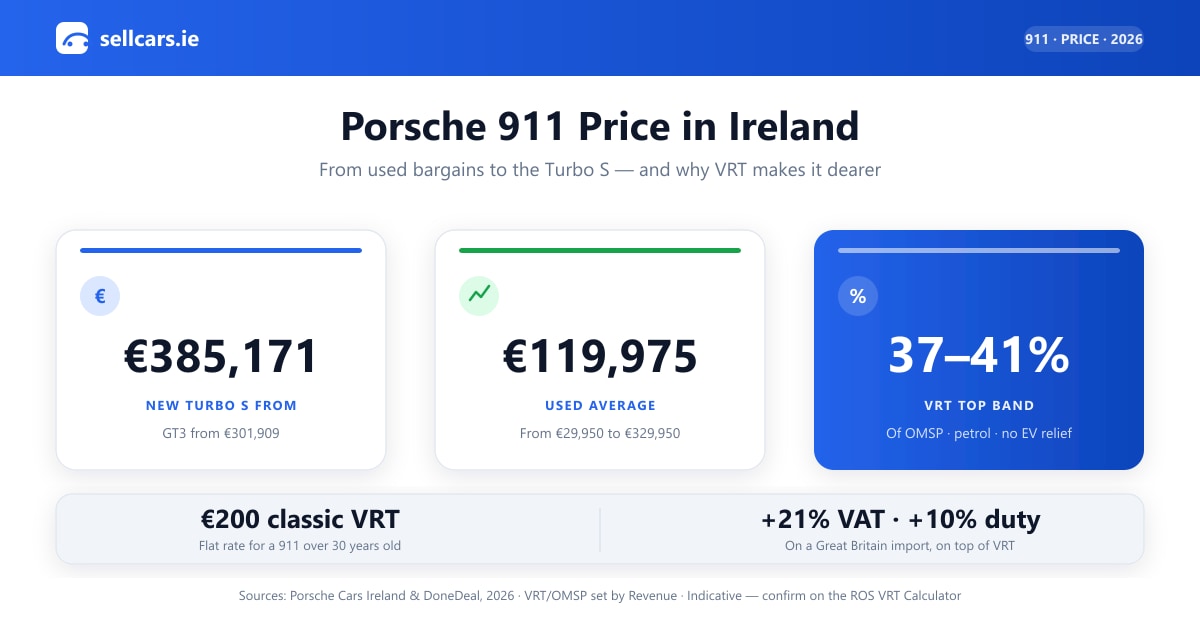
A new Porsche 911 in Ireland starts in the six figures and climbs beyond €385,000 for the Turbo S, while used examples sell from about €30,000 to over €290,000 depending on the variant, generation and mileage. The reason an Irish 911 costs more than a UK or mainland-European one is mostly tax: a petrol 911 is a high-CO₂ car, so it sits near the top VRT band — roughly 37–41% of the OMSP — with a NOx levy on top and no EV relief.
That matters whether you are eyeing a brand-new car at Porsche Centre Dublin, a tidy used coupé on DoneDeal, or a UK import. The headline figure on a configurator is not the same as the Open Market Selling Price (OMSP) that Revenue uses to set your tax, and the variant you pick swings the bill by hundreds of thousands of euro. This guide gives the full price range across the 911 line-up, explains how the Irish on-the-road cost is built, and shows what an import really adds. If you would rather start from the tax figure, you can run the numbers in our Porsche 911 VRT calculator first.
How much is a Porsche 911 in Ireland? Price by variant
Porsche 911 prices in Ireland span a huge range: an entry Carrera coupé is the cheapest way into the new range, the Turbo S sits beyond €385,000, and special editions like the Spirit 70 and Turbo 50 Years climb higher still. All figures below are illustrative — they move with options, availability, and the OMSP Revenue assigns — but they show the shape of the line-up.
| Variant | Body / role | Indicative Irish price (from) | Notes |
|---|---|---|---|
| 911 Carrera | Entry coupé | Six figures | Cheapest new 911 |
| Carrera S / 4S | Coupé | from ~€253,368 (Carrera S listing) | 4S adds all-wheel drive |
| Carrera GTS / 4 GTS | Coupé, now T-Hybrid | from ~€290,438 (GTS listing) | First hybrid 911 |
| 911 Targa 4S / 4 GTS | Open-top with roll bar | Premium over coupé | All-wheel drive |
| 911 Cabriolet | Convertible | Premium over coupé | Carrera/GTS Cabriolet |
| 911 Turbo | Performance flagship | High six figures | Twin-turbo |
| 911 Turbo S | Top series model | from €385,171 | Among the dearest |
| 911 GT3 / GT3 Touring | Track-bred road car | from €301,909 | Naturally aspirated |
| 911 GT3 RS | Hardcore track car | from €355,406 | 305 g/km CO₂ (Porsche) |
| 911 GT2 RS | Track-focused, limited | Top of the range | Rare, collector |
| 911 Sport Classic / Spirit 70 | Special edition | Spirit 70 from €366,922 | Limited build |
| 911 Carrera GTS T-Hybrid | Hybrid coupé | Premium GTS pricing | New hybrid drivetrain |
Use this table as a starting map, then open the dedicated page for the model you want — each variant has its own spec, options and resale story.
Entry to mid-range: Carrera, Carrera S, 4S and GTS
The 911 Carrera coupé is the natural entry point to the new range, with the Carrera S and all-wheel-drive Carrera 4S stepping up power and price. For context, Irish listings have shown a 2026 Carrera S around €253,368 (DoneDeal, 2026, indicative), and back in 2019 a Carrera S was €167,571 with the 4S at €177,124 (Complete Car, 2019). The GTS sits above them and, from 2026, uses the new T-Hybrid drivetrain.
Open-top and grand-touring: Targa and Cabriolet
If you want the open-air experience, the Targa 4S and Cabriolet carry a premium over the equivalent coupé. The Targa's distinctive roll-bar roof and standard all-wheel drive make it the grand-tourer of the range, while the Carrera Cabriolet keeps the classic soft-top silhouette — both add cost without changing the underlying VRT logic.
Performance flagships: Turbo, Turbo S, GT3, GT3 RS and GT2 RS
This is where prices accelerate. The Turbo S starts at €385,171 and the limited Turbo 50 Years at €389,118 (Porsche Cars Ireland, 2026). On the motorsport side, the GT3 opens at €301,909 and the GT3 RS at €355,406, with the track-focused GT2 RS topping the line as a rare collector car.
Special editions and the hybrid 911
Limited runs such as the Spirit 70 (from €366,922) and the Sport Classic command flagship money for their exclusivity. The big drivetrain news for 2026 is the Carrera GTS T-Hybrid — the first hybrid 911 — which pairs the flat-six with electrification while remaining, for VRT purposes, a high-CO₂ petrol-based car rather than a relief-eligible EV.
Why a Porsche 911 costs more in Ireland: VRT, OMSP and the NOx levy
A Porsche 911 costs more in Ireland mainly because of Vehicle Registration Tax: as a high-CO₂ petrol car it sits near the top VRT band, roughly 37–41% of the OMSP, with a NOx levy on top and no EV relief whatsoever (Revenue, illustrative). Those headline prices already include this tax — which is exactly why an Irish 911 looks dearer than the same car abroad.
What is the OMSP and why it matters
The Open Market Selling Price is the figure Revenue considers the car would sell for retail in Ireland, including all taxes — not the price you actually paid or the base figure on the configurator. VRT is a percentage of that OMSP, so the value Revenue assigns, not your invoice, drives the bill. A cheap private purchase abroad does not lower your OMSP, which is the single most misunderstood point in Irish 911 pricing.
Worked example: from sticker price to on-the-road cost
Take an imported Carrera with an illustrative OMSP of €150,000. The on-the-road maths runs like this:
- OMSP (Revenue valuation): €150,000 — illustrative, not your purchase price.
- VRT at the top band (~40%): about €60,000.
- NOx levy (petrol): capped at €600.
- Indicative VRT + NOx: roughly €60,600 added before VAT or duty.
The €200 classic exception for a 30-year-old 911
There is one place the tax collapses. A 911 that is more than 30 years old qualifies for the flat classic/vintage VRT of €200 (Revenue). That is why air-cooled cars such as the 964 and 993 are taxed at a token rate on registration — a genuine fiscal advantage if you are buying an older 911 rather than a modern one. Some sought-after air-cooled cars, like the original 911 Speedster, also sit in this bracket.
New, used or import: the cheapest way into a 911 in Ireland
The cheapest route into a Porsche 911 in Ireland is usually a well-kept older used car — listings start around €30,000 — while a brand-new 911 from an Irish Porsche Centre is the most expensive but most predictable option. Once you understand the tax stack, the channel you choose is what really decides how much 911 you get for your money.
Buying new from an Irish Porsche Centre
Buying new from Porsche Centre Dublin or Joe Duffy Porsche is the dearest path, but the price already includes VRT, you get the exact configuration, the manufacturer warranty, official service and clean resale history. For drivers who value predictability over saving, it is the simplest way to own a 911.
Used 911 prices by generation (996, 997, 991, 992)
Used pricing tracks the generation. As broad market orders of magnitude: the 996 is the entry point at around €30,000–€45,000; the 997 sits near €45,000–€80,000; the 991 runs roughly €70,000–€130,000+; and the current 992 is often above €130,000. Irish listings reflect this spread — Cars.ie has shown a Carrera S at €86,995, a Carrera T at €149,950 and a Turbo S at €329,950 (2026), with DoneDeal's average asking price around €119,975.
What it costs to import a Porsche 911 to Ireland
Importing a Porsche 911 from Great Britain adds 23% VAT and 10% customs duty on top of the VRT, so a UK bargain rarely stays a bargain once it is registered in Ireland; a car already in free circulation in Northern Ireland generally avoids the customs duty (Revenue, 2025–2026). An import can look cheaper at first glance, but the Irish tax stack changes the maths completely.
From Great Britain: VRT + 23% VAT + 10% duty
A 911 bought in Great Britain is treated as a full third-country import post-Brexit, so the charges stack on top of each other.
| Charge | Rate (Great Britain) |
|---|---|
| Customs duty | 10% |
| VAT | 23% |
| VRT | ~37–41% of OMSP (top band, no relief) |
On a six-figure car these add tens of thousands of euro, which usually erases the saving that made the British listing attractive. Estimate the VRT on the official ROS VRT Calculator before you commit, then register at the NCTS.
From Northern Ireland: usually no customs duty
A 911 already in free circulation in Northern Ireland generally carries no customs duty, which is why the Northern route is often the cheaper way to import. You still pay VRT based on the Irish OMSP, but avoiding the 10% duty can be the difference that makes an import worthwhile.