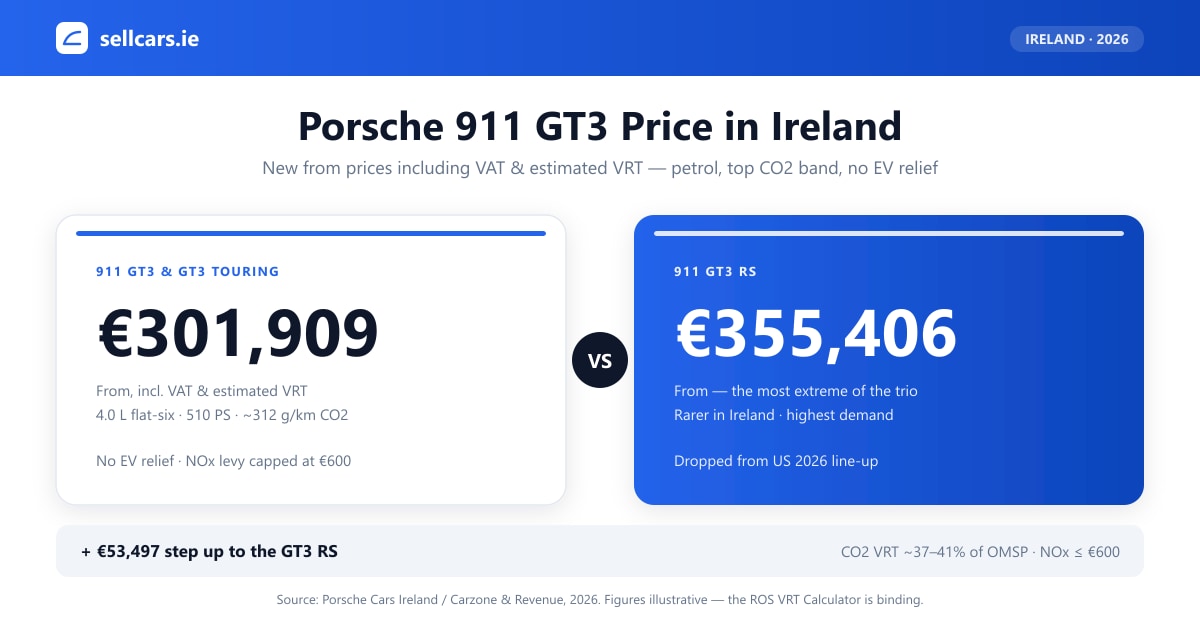
A new Porsche 911 GT3 costs from about €301,909 in Ireland — the GT3 and the GT3 with Touring Package share that starting price — while the more extreme GT3 RS starts from around €355,406, both including VAT and estimated VRT (Porsche Cars Ireland, 2026). That is far more than the US sticker price, and the gap is almost entirely down to one tax: Ireland's Vehicle Registration Tax (VRT).
The reason a 911 GT3 lands so high is that it is a petrol car emitting around 310–312 g/km of CO2 (Carzone, 2026), which drops it into the top Category A VRT band — roughly 37–41% of its OMSP — with a NOx levy on top and no electric-vehicle relief of any kind. Whether you are configuring new at Porsche Cars Ireland, watching the used and collector market on DoneDeal, or planning an import, the price you should budget for is the all-in figure once Revenue (the Office of the Revenue Commissioners) has had its say. This guide turns the headline numbers into a decision tool, with a fully worked VRT example and the real cost of importing a GT3 from Great Britain versus Northern Ireland.
How much does a Porsche 911 GT3 cost in Ireland?
In Ireland, the 911 GT3 and the 911 GT3 with Touring Package start from about €301,909, while the GT3 RS starts from around €355,406 — prices that already include VAT and estimated VRT (Porsche Cars Ireland / Carzone, 2026). Before breaking down why those numbers are so high, it helps to see exactly what each GT3 variant costs new on the Irish market.
911 GT3 and GT3 Touring: the starting point
The 911 GT3 and the 911 GT3 with Touring Package share an identical Irish starting price of about €301,909, including VAT and estimated VRT (Carzone, 2026). Mechanically they are twins: both use the same 4.0-litre naturally aspirated flat-six producing 510 PS and revving to 9,000 rpm, available with the 7-speed PDK or a manual 6-speed gearbox at no extra charge. The headline difference is the bodywork — the standard GT3 wears the dramatic fixed rear wing, while the Touring Package swaps it for a discreet automatic spoiler and a more understated look.
Both cars emit close to the same CO2 — 312 g/km for the GT3 and 310 g/km for the Touring (Carzone, 2026) — so they sit in the same place for tax. From that base, options climb quickly: the Weissach Package alone adds about €32,692 (Porsche configurator), and because Revenue values the car on its full retail specification, every box you tick feeds into the OMSP that ultimately drives the VRT.
- Engine: 4.0 L naturally aspirated flat-six, 510 PS, 9,000 rpm redline
- Transmission: 7-speed PDK or manual 6-speed (no cost difference)
- GT3 vs Touring: fixed wing versus retractable spoiler — same price, same drivetrain
911 GT3 RS: the most expensive of the trio
The 911 GT3 RS is the priciest of the family in Ireland, starting from around €355,406 (Porsche Cars Ireland, 2026) — roughly €53,000 above the standard GT3. That premium buys a far more extreme, circuit-focused machine: more aggressive aerodynamics, more downforce and a slightly higher output, with the RS built around lap times rather than everyday usability.
What makes the RS notable for Irish buyers is scarcity. Car and Driver reported that the more powerful GT3 RS was dropped from the US 2026 line-up (Car and Driver, 2026), yet Porsche Cars Ireland continues to list it — which concentrates demand on a limited number of cars. In a small market like Ireland, that combination of low supply and high desirability keeps both new allocations and used RS values firm. We will return to that demand dynamic in the comparison section below.
New 911 GT3 prices in Ireland at a glance
The table below summarises the three current variants, their Irish starting prices and where each sits for VRT. All figures are indicative and include VAT and estimated VRT as shown by Porsche Cars Ireland and Carzone (2026); the binding amount is always set by Revenue at registration.
| Variant | New from (Ireland, indicative) | Engine / power | CO2 | VRT position |
|---|---|---|---|---|
| 911 GT3 | ~€301,909 incl. VAT & est. VRT | 4.0 L flat-six, 510 PS | 312 g/km | Top Category A band |
| 911 GT3 with Touring Package | ~€301,909 incl. VAT & est. VRT | 4.0 L flat-six, 510 PS | 310 g/km | Top Category A band |
| 911 GT3 RS | ~€355,406 incl. VAT & est. VRT | 4.0 L flat-six (uprated) | High (petrol) | Top Category A band |
Why is the 911 GT3 so expensive in Ireland? VRT explained
The 911 GT3 is so expensive in Ireland mainly because of VRT: as a petrol car emitting around 310–312 g/km of CO2, it falls into the highest Category A band, where VRT is roughly 37–41% of the car's OMSP (Revenue, 2026). Those starting prices look steep next to the US or continental figures, and the gap comes down almost entirely to that one Irish tax.
To put the contrast in perspective, Car and Driver lists the 2026 GT3 at a US MSRP of $238,150 (Car and Driver, 2026) and Porsche France advertises it from about €213,700 TTC (Porsche France) — neither of which transfers to Ireland. The Irish price is higher precisely because the VRT charge is layered onto a high OMSP. Here is how that charge is built.
How VRT is calculated on a petrol GT3
VRT on a petrol passenger car is a percentage of the OMSP set by CO2 emissions, and the GT3's ~310–312 g/km puts it firmly in the top band — about 37–41% of the car's open market selling price (Revenue, 2026). In plain terms, the dirtier the car on paper, the higher the percentage, and a 9,000-rpm naturally aspirated supercar is about as far up the CO2 scale as a road car goes.
The simplified formula for a GT3 looks like this:
There is no relief term to subtract, which is the single biggest reason the GT3's Irish price towers over its US sticker. Every euro of OMSP is taxed at that top rate, so a high-value car generates a very large VRT charge before the NOx levy is even added.
The NOx levy and why it's capped at €600
The NOx levy applies to the GT3, but it is capped at €600 because the car runs on petrol (Revenue, 2026). The levy is charged on a car's nitrogen-oxide emissions, and the rules set different ceilings by fuel type — petrol cars are capped at €600, well below the much higher ceiling that can apply to diesels.
For a buyer, the practical takeaway is reassuring on this one line item: no matter how the NOx figure is calculated for a particular GT3, the petrol cap means it cannot exceed €600. Against a CO2 charge running into tens of thousands of euro, the NOx levy is a rounding error — but it is still a real, separate component you should include when you budget the total registration cost.
No EV relief: the GT3 is a pure petrol car
The 911 GT3 qualifies for no electric-vehicle relief whatsoever, because it is a pure petrol car — a 4.0-litre naturally aspirated flat-six with no electrification (Porsche, 2026). This is the point Irish buyers most often get wrong, having read that "EVs are cheap to register" and assumed some of that benefit trickles down. It does not.
EV relief is reserved for battery electric vehicles, which sit in the lowest CO2 band and can deduct up to several thousand euro from their VRT. The GT3 is the opposite case: top CO2 band, full percentage applied, no deduction. That is why a calculation that would knock thousands off an electric car adds nothing here, and why the GT3's all-in Irish figure is so much larger than markets without a CO2-linked registration tax.
Worked example: the real registration cost of a 911 GT3
For an illustrative 911 GT3 with an OMSP of €300,000, the CO2 VRT at a top-band rate of around 39% would be roughly €117,000, plus a NOx levy capped at €600 — a registration cost of about €117,600 on top of the car. The band figures become far clearer once they are applied to a real OMSP, so here is the calculation worked from end to end. Every euro figure below is illustrative; only Revenue's valuation is binding.
Step by step: OMSP, CO2 charge and NOx levy
Take the OMSP as the starting point — the retail value Revenue assigns to the car, inclusive of all taxes. Apply the top Category A CO2 rate, then add the petrol-capped NOx levy. Using an illustrative OMSP of €300,000 and a top-band rate of about 39% (within the ~37–41% range cited by Revenue, 2026):
- OMSP (illustrative): €300,000
- CO2 VRT at ~39%: ~€117,000
- NOx levy (petrol, capped): up to €600
- Total estimated VRT: ~€117,600
That single calculation explains the whole story: the VRT charge on a GT3 can rival the entire pre-tax value of a more ordinary car. For context, Carzone separately lists a CO2 VRT figure of about €2,400 on the emissions portion for the GT3 (Carzone, 2026) — a reminder that published quick-quotes can differ from a full OMSP-based charge, which is exactly why you should rely on the official estimate rather than any single headline number.
What the OMSP means and why a low-mileage GT3 stays expensive
VRT is based on the OMSP Revenue assigns to the car, not on the price you actually paid (Revenue, 2026). The OMSP is Revenue's view of what the car would sell for retail in Ireland, including all taxes — so a sharp private deal abroad does not lower it, and a well-specified car raises it.
This is why a low-mileage or collector GT3 keeps a high OMSP, and therefore a high VRT, even years after it was new. A GT3 with delivery miles is, in Revenue's eyes, still close to a new car in value. Buyers hoping that an older registration date will slash the tax are usually disappointed: until the car is genuinely old (see the classic rule in the FAQ), its OMSP — and its VRT — stays stubbornly high.
Always check the official ROS VRT Calculator
The figures in this article are illustrative; the binding amount comes from Revenue's official ROS VRT Calculator (Revenue Online Service). Before committing to any GT3 purchase or import, run the specific car through the calculator or Revenue's VRT enquiry system to get a quote tied to its actual OMSP.
Treat any euro figure here as a worked illustration of the method, not a quote for your car. Revenue and ROS are the final authority, and a few minutes on the calculator will give you a number you can budget against with confidence.
GT3 vs GT3 Touring vs GT3 RS: price and Irish demand
The GT3 and GT3 Touring share the same starting price of about €301,909, while the GT3 RS commands around €355,406 — and in Ireland the RS and the wingless Touring are the variants buyers chase hardest (Porsche Cars Ireland, 2026). Knowing the headline prices is one thing; choosing between the three GT3 flavours on the Irish market is another, because demand and resale behave differently.
The Touring Package: same price, different character
The GT3 Touring costs the same as the standard GT3 — about €301,909 — but trades the fixed rear wing for a retractable spoiler and a far more understated look (Porsche Cars Ireland, 2026). Underneath it is the identical 510 PS naturally aspirated car, so you pay nothing extra for the subtlety.
That restraint is precisely why the Touring is so coveted. Many Irish buyers who want GT3 thrills without the overt track-car aesthetic gravitate to it, and because Porsche allocates limited numbers, a well-specified Touring can be just as hard to secure as the wilder versions. For VRT it sits in the same top band as the standard GT3, so the tax treatment is unchanged.
The GT3 RS: rarer, pricier, highly sought after in Ireland
The GT3 RS is the most expensive and most sought-after of the three in Ireland, starting from around €355,406 (Porsche Cars Ireland, 2026). With the RS reportedly dropped from the US 2026 line-up (Car and Driver, 2026) yet still offered in Ireland, the small local pool of cars meets concentrated demand — which supports both new allocations and used values.
The table below compares the trio on price, character and Irish desirability. All prices are indicative new-from figures including VAT and estimated VRT.
| Variant | New from (indicative) | Character | Irish demand |
|---|---|---|---|
| 911 GT3 Touring | ~€301,909 | Understated, no fixed wing | Very high (subtle look) |
| 911 GT3 | ~€301,909 | Classic fixed-wing GT3 | High |
| 911 GT3 RS | ~€355,406 | Extreme, track-focused | Highest (limited supply) |
Used and collector 911 GT3 prices in Ireland
On the Irish used market, low-mileage 911 GT3s rarely come cheap: recent listings range from around €134,995 for an older 991-generation GT3 to about €237,500 for a near-new GT3 Clubsport with under 19,000 km (DoneDeal, 2026). Not everyone buys new from Porsche Cars Ireland, and the second-hand and collector market follows its own pricing logic — one Revenue still values closely.
What stands out is how little these cars depreciate. A 2021 GT3 Clubsport with roughly 19,000 km was listed at about €237,500 by a dealer (Bespoke Motors / DoneDeal, 2026), while a 2018 991-generation GT3 with 22,772 km showed up elsewhere on the same marketplace. Across the listings, mileage stays low and asking prices stay firm — these are cars that are driven sparingly and held as appreciating assets.
That resilience has a direct tax consequence. Because the OMSP stays high on low-mileage examples, a used GT3 attracts a high VRT if it is imported or first registered in Ireland — the age of the registration does little to soften Revenue's valuation. Buyers shopping the used and collector market should budget on the same OMSP-driven basis as for a new car.
- Older 991 GT3: from around €134,995 (DoneDeal, 2026)
- 2021 GT3 Clubsport, ~19,000 km: about €237,500 (Bespoke Motors / DoneDeal, 2026)
- 2018 991 GT3, 22,772 km: actively listed (DoneDeal, 2026)
The cost of importing a 911 GT3 to Ireland
Importing a 911 GT3 from Great Britain adds customs duty of 10% and VAT at the current 23% standard rate on top of the VRT, whereas a car routed through Northern Ireland is treated differently and can avoid the customs duty (Revenue, 2026). Because Irish supply of the GT3 is thin, many buyers look abroad — and where the car comes from changes the final bill dramatically.
From Great Britain: VRT + 10% customs duty + 23% VAT
A GT3 brought in from Great Britain is treated as a third-country import after Brexit, so three charges stack up: customs duty of 10%, VAT at the current Irish standard rate of 23%, and then VRT on the Irish OMSP (Revenue, 2026). On a car worth several hundred thousand euro, the duty and VAT alone add a very large sum before VRT is even calculated.
The table below sets out the two routes side by side. Treat every percentage as the headline rule and confirm your specific case with Revenue.
| Route | Customs duty | VAT | VRT |
|---|---|---|---|
| Great Britain | 10% | 23% (current Irish standard rate) | Yes, on Irish OMSP |
| Northern Ireland | None in many cases | Conditional (see below) | Yes, on Irish OMSP |
The Northern Ireland route is different
A GT3 sourced through Northern Ireland generally avoids the 10% customs duty and is treated differently from a Great Britain import (Revenue, 2026). VAT may still apply depending on the car's status — in particular whether it counts as a new means of transport — but the absence of customs duty often makes the NI route materially cheaper than buying the same car in Great Britain.
Because the rules turn on the car's history and how it entered Northern Ireland, this is the area where buyers most often get caught out. Always verify the duty and VAT position for the exact car with Revenue before you commit.
Registering an imported GT3: NCTS and the 30-day deadline
Once a GT3 arrives in Ireland, you must register it at an NCTS centre within 30 days of its arrival (Revenue / NCTS). Late registration can trigger penalties, so book the appointment as soon as the car lands and bring the documentation Revenue requires.
The sequence is straightforward: estimate the VRT on the ROS VRT Calculator, book the NCTS inspection, present the car and its paperwork, and pay the VRT due on Revenue's OMSP valuation — all inside the 30-day window.