The Porsche 911 hybrid — officially the 992.2 911 Carrera GTS T-Hybrid, the first hybrid 911 — starts at around €266,696 in Ireland through Porsche Cars Ireland. That headline figure already bakes in heavy VRT and 23% VAT, because this is a high-CO2 performance hybrid, not a plug-in or an EV. With combined emissions of 230–241 g/km, it sits in a high VRT band, pays the NOx levy, and receives no EV VRT relief whatsoever.
This matters the moment you compare Ireland to other markets, because the same car lists for roughly £133,000 in the UK and $166,895 in the US. The gap is tax, not Porsche being greedy with Irish customers. Revenue (the Office of the Revenue Commissioners) sets the rules and is the final authority on what you pay, while Porsche Cars Ireland sets the showroom price. This guide turns both into a single answer: what a 911 T-Hybrid genuinely costs to put on Irish roads, whether you buy new here or import one.
How much is the Porsche 911 hybrid in Ireland?
The Porsche 911 Carrera GTS T-Hybrid starts at around €266,696 through Porsche Cars Ireland, and that headline figure already includes VRT and 23% VAT — it is a recommended retail price before options. In other words, the number you see is close to what you would drive away in, not a pre-tax sticker that taxes are later added to. Before comparing markets, it helps to be clear about exactly which 911 is the hybrid and what the Irish price actually covers.
That RRP is the starting point for a base GTS T-Hybrid specification. Porsche's options list is famously deep, and on a car at this level it is easy to add tens of thousands in paint, wheels, interior trim and dynamic packages. Every euro of factory options also lifts the value Revenue uses for tax, so the configurator total and the final registered price both climb together.
Which 911 is the hybrid? The Carrera GTS T-Hybrid
For now, there is only one hybrid 911, and it is the Carrera GTS T-Hybrid within the facelifted 992.2 generation (Top Gear). Porsche calls it a T-Hybrid — the "T" stands for turbo — and it sits in the sweet spot of the range, above the standard Carrera and below the Turbo and GT3 derivatives. If a search result mentions a "hybrid 911", it is referring to this GTS; no other 911 variant currently offers the system.
That single-variant status is important for budgeting. You cannot order a cheaper hybrid 911, so the GTS T-Hybrid's RRP is effectively the entry price for hybrid 911 ownership in Ireland. Everything else in the 911 line-up is petrol-only.
What the Irish RRP includes (and what it doesn't)
The Irish RRP of about €266,696 includes VRT and 23% VAT, because it is the price of a new car sold domestically by an authorised dealer (Porsche Cars Ireland, 2026). That is why it is not directly comparable to a UK or US figure quoted before each country's own taxes. What the RRP does not include is your chosen options, delivery-related extras, or the cost of any aftermarket additions.
This distinction becomes critical the moment you consider importing instead of buying new. An import price quoted abroad has none of Ireland's taxes in it, so VRT, VAT and possibly customs duty have to be added back on. Buy new here and the dealer has already handled all of that inside the RRP.
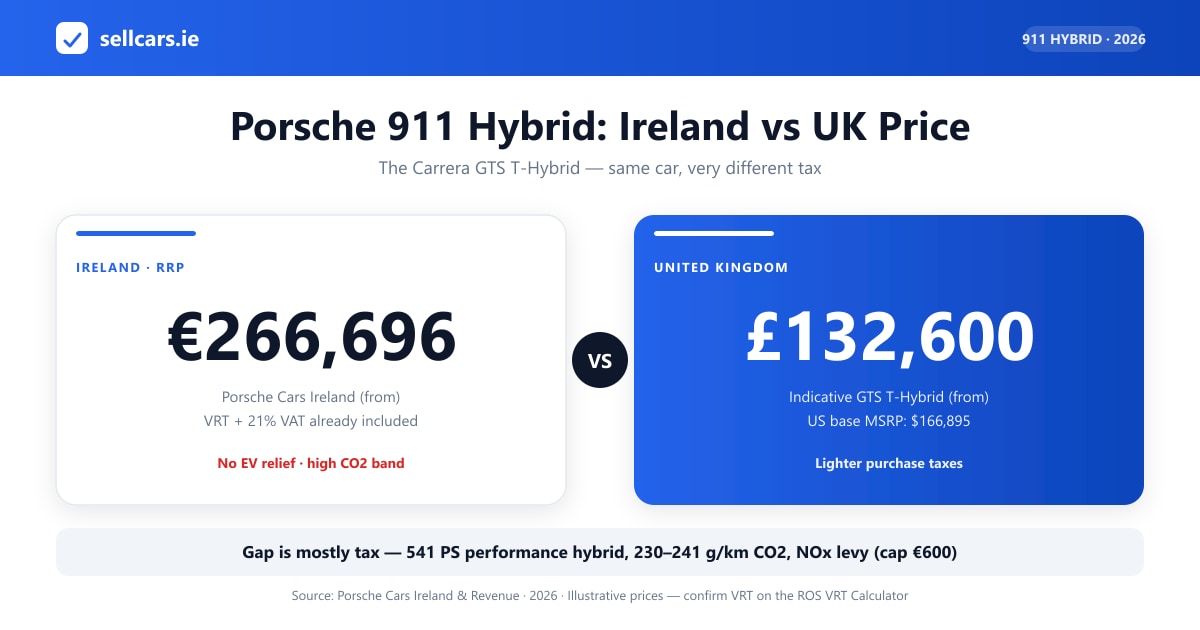
Porsche 911 hybrid price: Ireland vs the UK and US
At around €266,696 in Ireland, the 911 T-Hybrid costs far more than the roughly £132,600–£135,834 UK price or the $166,895 US base MSRP, and the gap is mostly tax — VRT and 23% VAT — not Porsche pricing. Seeing the Irish figure beside other markets is where the cost of registering a high-emission performance car in Ireland becomes obvious.
These figures are not like-for-like: each is quoted in its own currency under its own tax regime, and exchange rates and local option packs shift the picture further. But the direction of travel is clear. A car that lists around £133,000 in Britain arrives in Ireland as a near-€267,000 proposition once Irish taxes are applied, and almost all of that difference is registration tax and VAT.
Why Ireland is so much more expensive
The Irish price is higher mainly because VRT and 23% VAT are integrated into the RRP, and VRT on a high-CO2 car is substantial. VRT for a passenger car is a percentage of the OMSP set by CO2 emissions; at 230–241 g/km, the 911 T-Hybrid falls into a high band, so the tax it carries is large in cash terms even before VAT (Revenue, 2026). Add a NOx levy on top, and a meaningful share of the Irish price is Irish tax rather than the car itself.
By contrast, the UK and US headline prices reflect different and generally lighter purchase-tax structures for a car like this. That is the whole reason a straight currency conversion of the UK figure looks so much lower than the Irish RRP — it is comparing a tax-light price against a tax-heavy one.
A quick market price comparison
The table below sets the three markets side by side. Treat the UK and US figures as indicative starting prices in their own currencies; only the Irish RRP includes Irish VRT and VAT.
| Market | Starting price | Currency | Note |
|---|---|---|---|
| Ireland (Porsche Cars Ireland) | ~€266,696 | EUR | RRP, includes VRT + 23% VAT, before options |
| United Kingdom | ~£132,600–£135,834 | GBP | Indicative GTS T-Hybrid price |
| United States | $166,895 | USD | Base MSRP |
Read the table for what it is: a snapshot of how the same hybrid 911 is priced under three tax systems. The Irish premium is not a different car — it is the same GTS T-Hybrid carrying Ireland's registration tax and VAT.
Why the 911 T-Hybrid gets no VRT relief (it's a performance hybrid, not an EV)
The 911 T-Hybrid receives no VRT relief at all: the hybrid VRT relief ended on 31 December 2020, and the €5,000 EV relief is reserved for battery electric vehicles — and with 230–241 g/km of CO2 this car is the opposite of low-emission (Revenue). The single biggest misconception buyers carry into this purchase is that the word "hybrid" buys a tax break. For this car, it does not.
It is an easy mistake to make. Plenty of hybrids over the years did attract reduced VRT, and EVs still benefit from a generous relief today. But the 911 T-Hybrid belongs to neither group: the old hybrid scheme is closed, and the EV scheme does not apply to a petrol-driven car. The hybrid badge here is about speed, not savings.
The hybrid VRT relief ended in 2020
The dedicated VRT relief for hybrid vehicles expired on 31 December 2020 (Revenue). Any expectation that buying a hybrid in Ireland still trims your registration tax is years out of date. Since then, the only meaningful VRT relief on the books for low-emission cars is the €5,000 relief for battery electric vehicles, and even that is tied to OMSP limits and BEV status.
A performance hybrid like the 911 T-Hybrid is taxed exactly as a high-emission petrol car would be. There is no half-rate, no hybrid discount and no special category that softens the bill. Planning around a relief that no longer exists is the fastest way to under-budget this purchase.
T-Hybrid vs plug-in: no charging, no electric range
The T-Hybrid system adds performance, not autonomy. It pairs a 3.6-litre flat-six with an electric motor inside the turbocharger and a second motor in the PDK gearbox, fed by a small 1.9 kWh battery (Porsche; Top Gear). You cannot plug it in, and there is no electric-only range — the battery is charged by regenerative braking and exhaust energy, and exists purely to sharpen response and add speed.
That engineering choice is exactly why the tax treatment is unforgiving. A plug-in or full EV cuts tailpipe CO2 and earns the relevant reliefs; the 911 T-Hybrid keeps a thirsty, high-output petrol engine and posts CO2 of 230–241 g/km. It is a hybrid in the technical sense, but a high-emission performance car in the eyes of Revenue.
How VRT works on the 911 T-Hybrid: CO₂ band, NOx levy and OMSP
VRT on the 911 T-Hybrid is a high percentage of its OMSP, because the tax is set by CO2 emissions, and at 230–241 g/km the car sits in the top band — plus a NOx levy capped at €600 for petrol and hybrid cars (Revenue, 2026). Once you accept there is no relief, the amount comes down to two Revenue figures: the OMSP and the CO2 band it triggers.
There is no shortcut around either number. The CO2 band is fixed by the car's official emissions, which for the T-Hybrid land firmly at the top of the scale. The OMSP is set by Revenue, not by you, and it is the base everything is calculated against. Get those two right and the VRT is predictable; guess at them and you will mis-budget.
What is the OMSP and why it matters
The Open Market Selling Price is the price Revenue considers the car would sell for retail in Ireland, inclusive of all taxes — not the price you paid abroad and not the base figure on a configurator. Revenue maintains its own valuations, so a keen private deal in Britain does not lower your OMSP, and adding factory options pushes it up.
This matters because VRT is a percentage of the OMSP, so a higher OMSP means a higher cash VRT even at the same CO2 band. The only way to see the figure Revenue will actually use is the official ROS VRT Calculator — working from the purchase price is the most common and most expensive mistake buyers make.
The NOx levy on a petrol hybrid (capped at €600)
On top of the CO2-based VRT, a petrol or hybrid car pays a NOx levy, which is capped at €600 for petrol and hybrid vehicles (Revenue). Because the 911 T-Hybrid still runs a combustion engine, it is liable for this charge — another reminder that "hybrid" does not equal "clean" in tax terms. The €600 cap means the NOx component is a fixed worst case rather than an open-ended figure, but it is a real addition to the bill that a BEV would not face.
Taken together, the high-band CO2 charge and the capped NOx levy are why the registered cost of a 911 T-Hybrid is so heavy. Neither is reducible by the hybrid system; both flow directly from running a high-emission petrol engine.
Importing a Porsche 911 T-Hybrid to Ireland: the real road cost
Importing a 911 T-Hybrid from Great Britain adds VRT, 23% VAT and 10% customs duty on top of the purchase price, so the apparently cheaper UK car can end up close to the Irish RRP once everything is paid (Revenue). Because the UK figure looks so much lower, the obvious question is whether importing beats buying new in Ireland — and the answer hinges on those three extra charges.
A car imported from a Northern Ireland source can follow a different route, since goods properly in free circulation there are not treated the same as a Great Britain import. The detail depends on the car's history and paperwork, so it is worth confirming the specific position with Revenue before committing. Whichever route you take, none of the tax magically disappears just because the car was cheaper abroad.
Great Britain: VRT + 23% VAT + 10% customs duty
A Great Britain import is, since Brexit, a third-country import, so the bill stacks up: the purchase price, then VRT (the same high-band CO2 charge plus the NOx levy), then 23% VAT, then 10% customs duty (Revenue). The table below shows how an illustrative purchase turns into an Irish road cost. Every euro figure here is illustrative only — the binding numbers come from Revenue's valuation and the ROS VRT Calculator.
| Cost element | Basis | Adds to Irish road cost? |
|---|---|---|
| UK purchase price | What you pay the seller (GBP) | Yes — the starting point |
| Customs duty | 10% (Great Britain import) | Yes |
| VAT | 23% (Irish import VAT) | Yes |
| VRT | High CO2 band × OMSP | Yes |
| NOx levy | Capped at €600 (petrol/hybrid) | Yes |
Stacked on a six-figure car, those four charges are substantial. The cheaper UK headline can quickly converge on the Irish RRP — and once you account for transport, currency and risk, the saving may be slimmer than it first appears.
Worked example: UK purchase to Irish road cost
Imagine buying a used GTS T-Hybrid in Britain. The path to an Irish road cost runs as follows (illustrative figures, not Revenue valuations):
- Step 1 — Purchase price: what you agree with the UK seller, converted to euro.
- Step 2 — Customs duty: add 10% as a Great Britain import.
- Step 3 — VAT: add 23% Irish import VAT.
- Step 4 — VRT: apply the high CO2 band to Revenue's OMSP for the car.
- Step 5 — NOx levy: add up to €600.
- Step 6 — Total: the sum is your real road cost — compare it against the Irish RRP, not the bare UK price.
Registering your 911 T-Hybrid: NCTS, the 30-day deadline and the VRT calculator
An imported 911 T-Hybrid must be registered within 30 days of arriving in Ireland at an NCTS appointment, after estimating the VRT on Revenue's official ROS VRT Calculator (Revenue; NCTS). If you do import, the step that turns the deal into an Irish-registered car is the NCTS examination — and the clock starts the day it lands.
Missing that window is what triggers penalties, so the practical advice is simple: estimate the cost first, then book early. The two steps below cover the sequence that actually matters.
Step 1 — Estimate the VRT on the ROS calculator
Before anything else, use the ROS VRT Calculator to estimate the VRT, because it reflects the OMSP Revenue will apply to that specific car (Revenue). This is the single most useful thing you can do to avoid a nasty surprise: it converts the abstract "high CO2 band" into a euro figure for your exact vehicle and specification. Treat the result as your planning number, and remember it is an estimate confirmed at registration.
Step 2 — The NCTS appointment and the 30-day deadline
Registration runs through the NCTS, and the timeline is fixed:
- Book an NCTS examination appointment as soon as the car arrives in the State.
- Bring the vehicle for physical examination on the appointed date.
- Provide the supporting documents (proof of import, vehicle papers, identity).
- Complete registration and pay any VRT due — within 30 days of arrival.
Leaving the booking until the paperwork is perfect is how people slip past the deadline, so secure the appointment early and work backwards from it.